1,234 HELD-OUT QUERIES
FROZEN MODEL & SETTINGS
NO LLM DURING RETRIEVAL
CONTROLS INCLUDED
01 / RESULTS
The results, in plain language
Across 1,234 held-out questions, the system sometimes combined relationships learned in separate events. The cards below summarize what changed, what it was compared with, and how many examples were tested. Detailed methods and charts follow.
21.31%
After learning A→B and later B→C, memory recovered the new link A→C in 263 of 1,234 questions. Static memory and the memoryless comparison scored 0.
TOP-1 ACCURACY · 1,234 HELD-OUT QUESTIONS
Memoryless Baseline
0.00%
100.0%
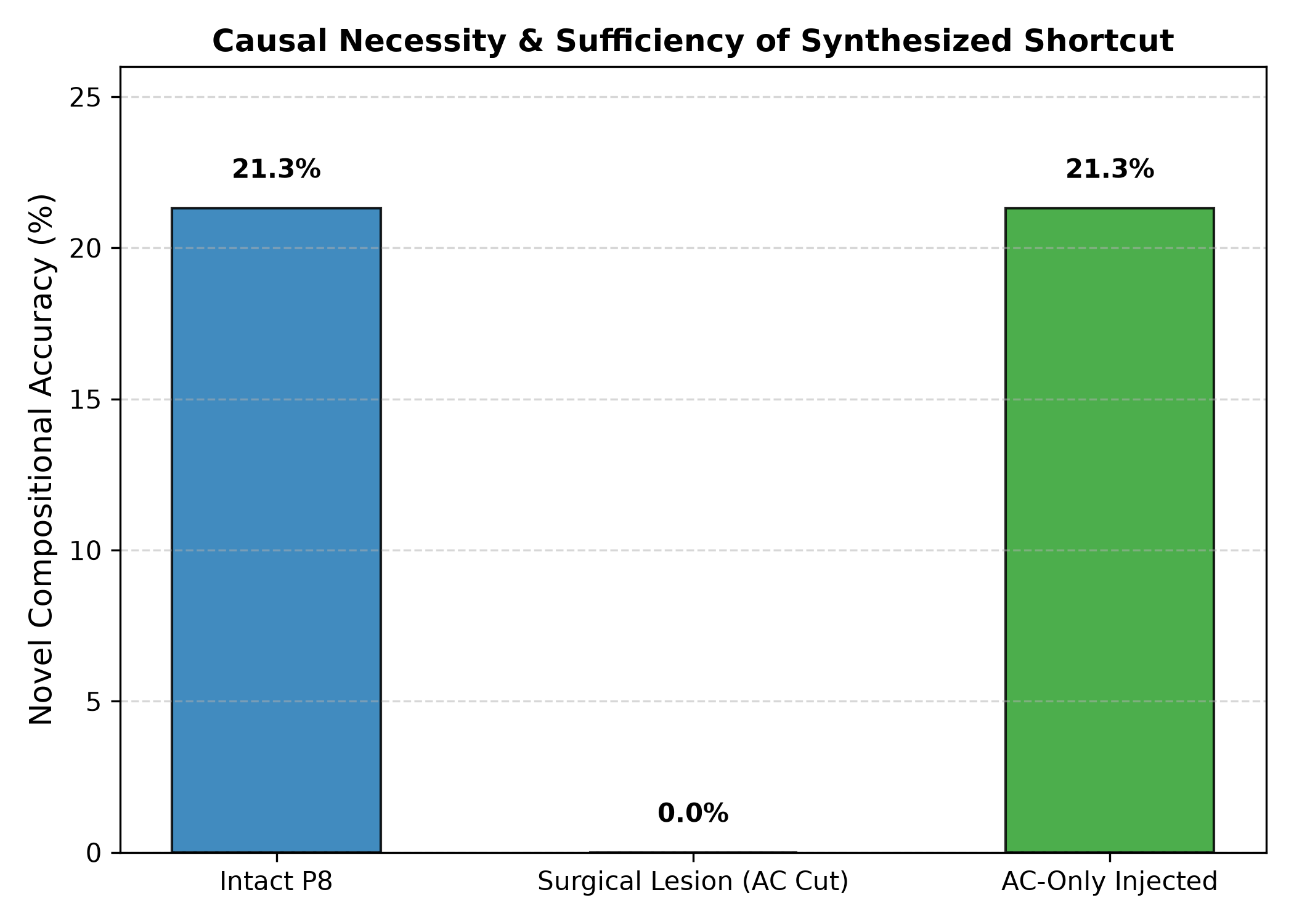
Removing just the learned A–C link changed all 263 successful answers to failures. That suggests the link mattered in these tested cases.
LINK REMOVAL CHECK · 263 SUCCESSFUL CASES RETESTED
Lesion Causal Loss
100.0%
Intact Substrate Loss
0.0%
+20.91 pp
The learned link outperformed a random link with the same weight: 21.31% accuracy versus 0.41% on the same benchmark.
DIFFERENCE · +20.91 PERCENTAGE POINTS
100.0%
Adding only the learned A–C link back to the original memory restored all 263 successful answers in this retest.
LINK-ONLY RESTORATION CHECK · 263 OF 263
79.1%
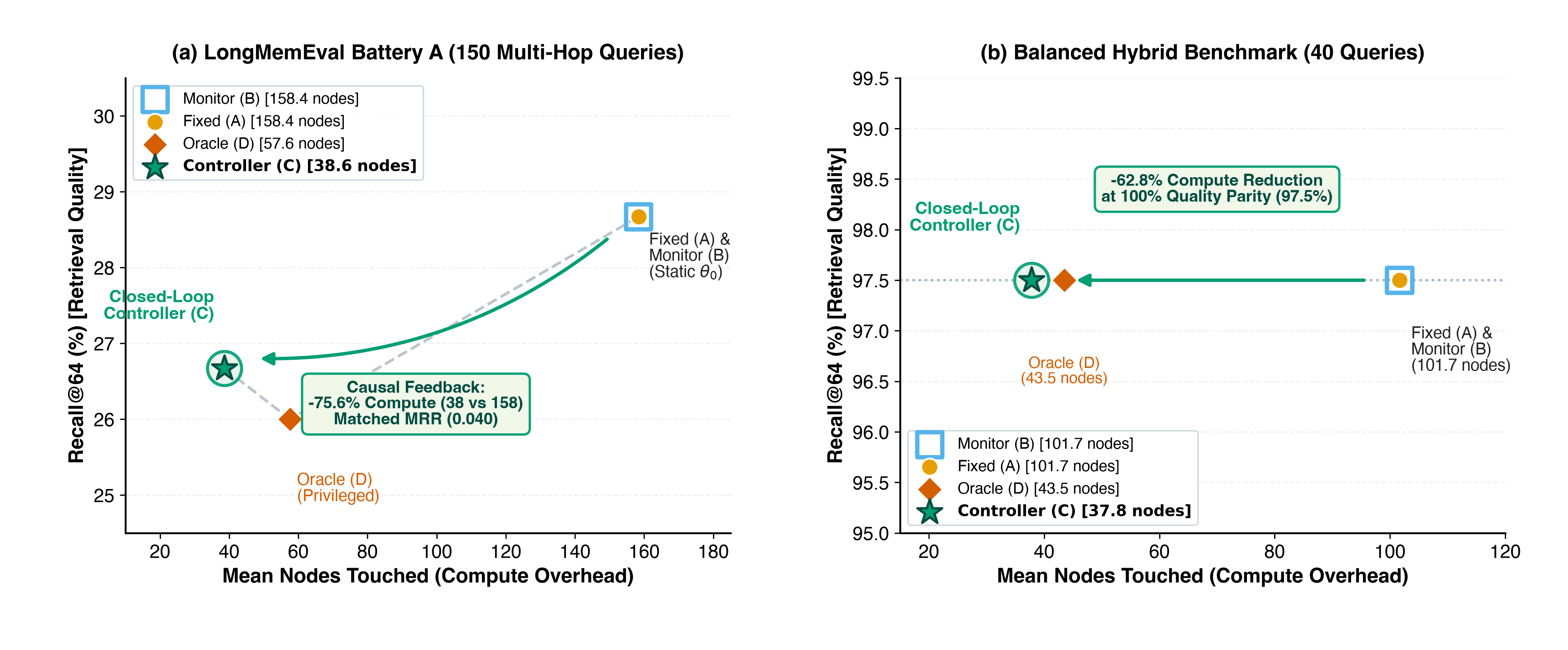
The search controller explored fewer memory nodes before stopping, while multi-step recall stayed comparable (+3.33% at Recall@64).
AVERAGE NODES EXPLORED · 150 TESTS
Adaptive search
38.6 nodes
Fixed Schedule
158.4 nodes
100.0%
After 10 fact updates, the system returned the current version every time. Raw retrieval included outdated facts in 40% of these checks.
FACT-UPDATE CHECKS · 20 TESTS
02 / THE CORE TEST
Can memory connect two facts learned at different times?
IN SHORT
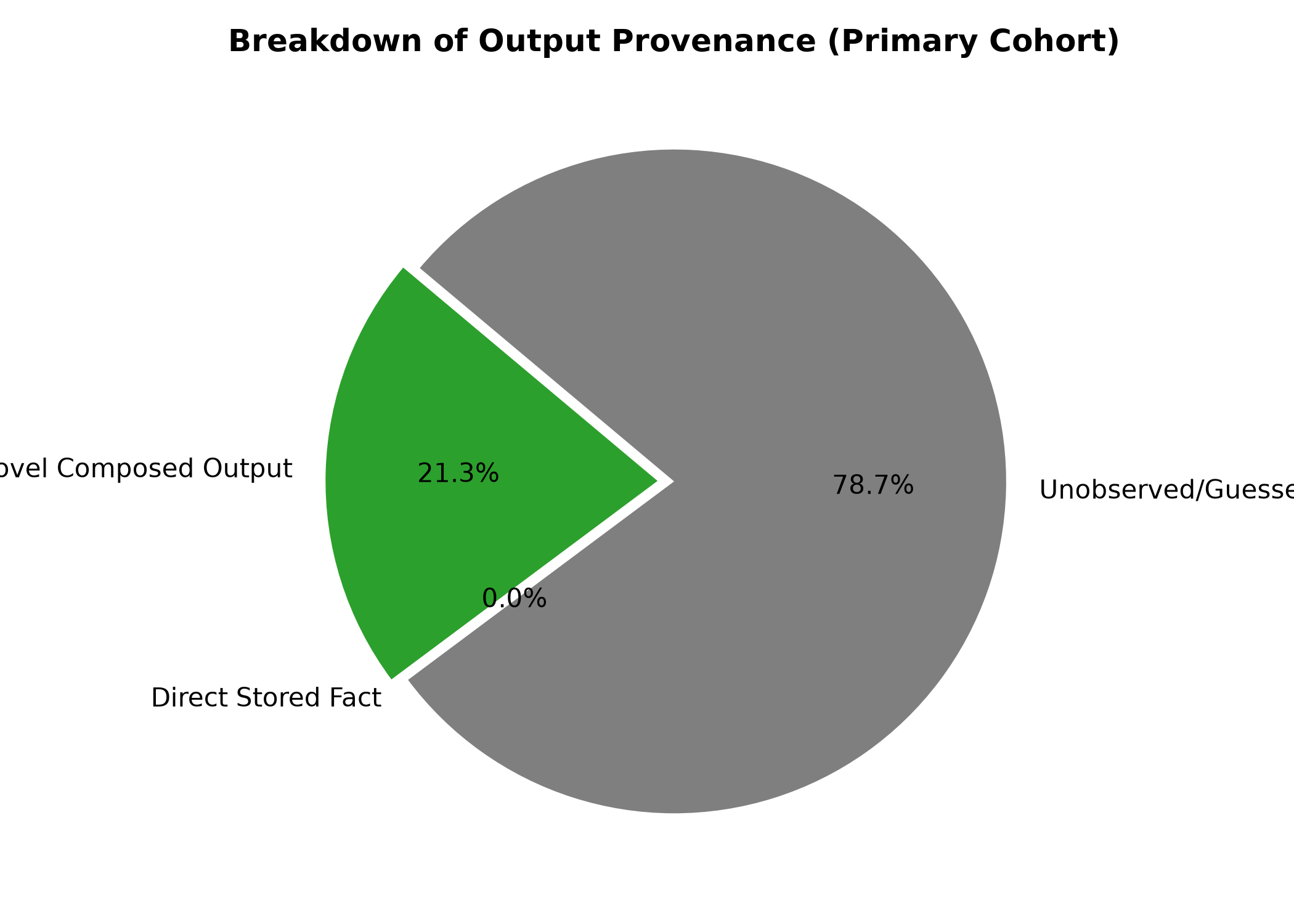
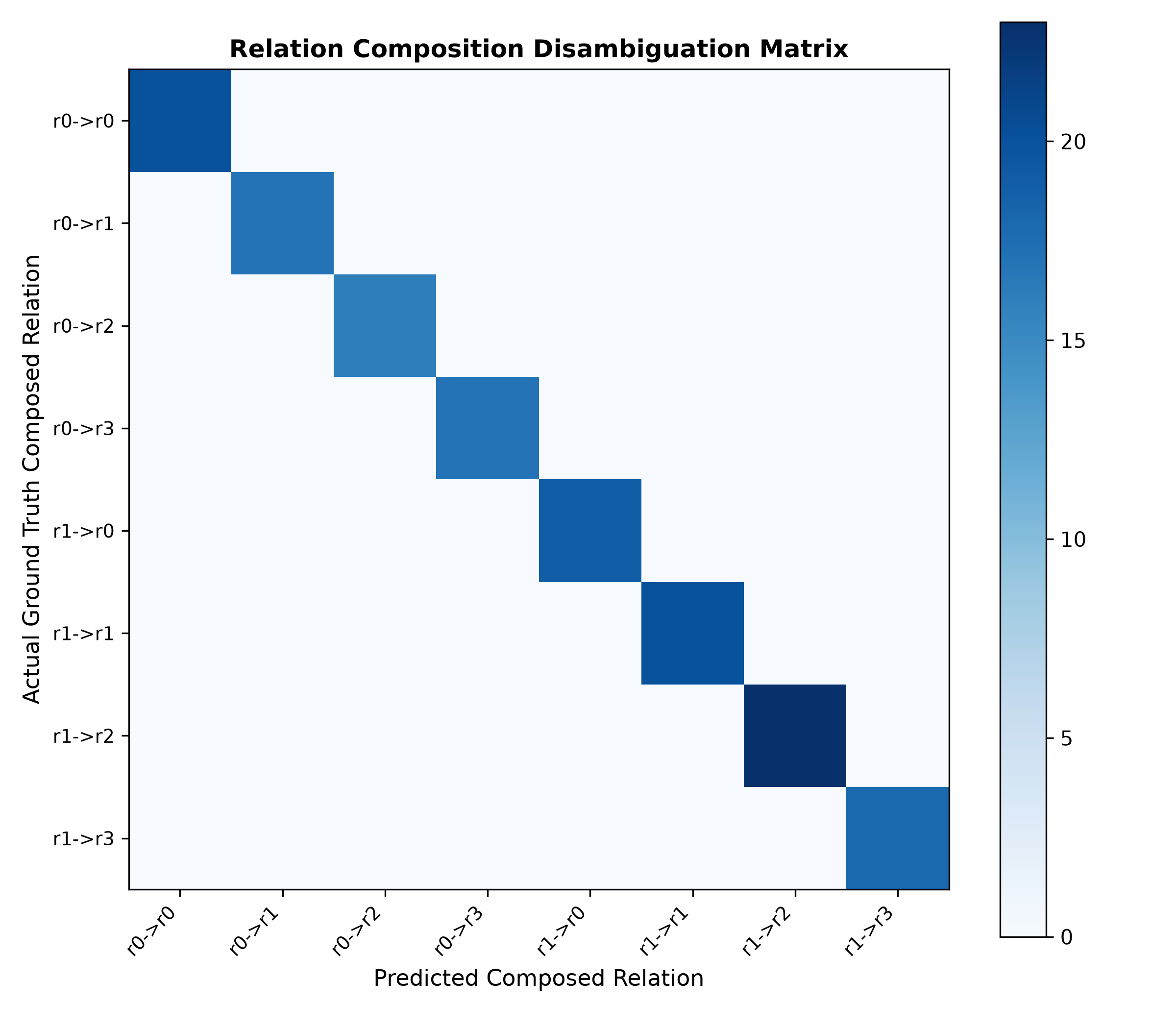
We gave the system two facts—A→B, then B→C—and later asked for the connection from A to C. It found the right answer in 263 of 1,234 questions; the static and memoryless comparisons scored zero.
Can an AI agent's persistent memory synthesize genuinely new conclusions that were never directly stored as explicit associations?
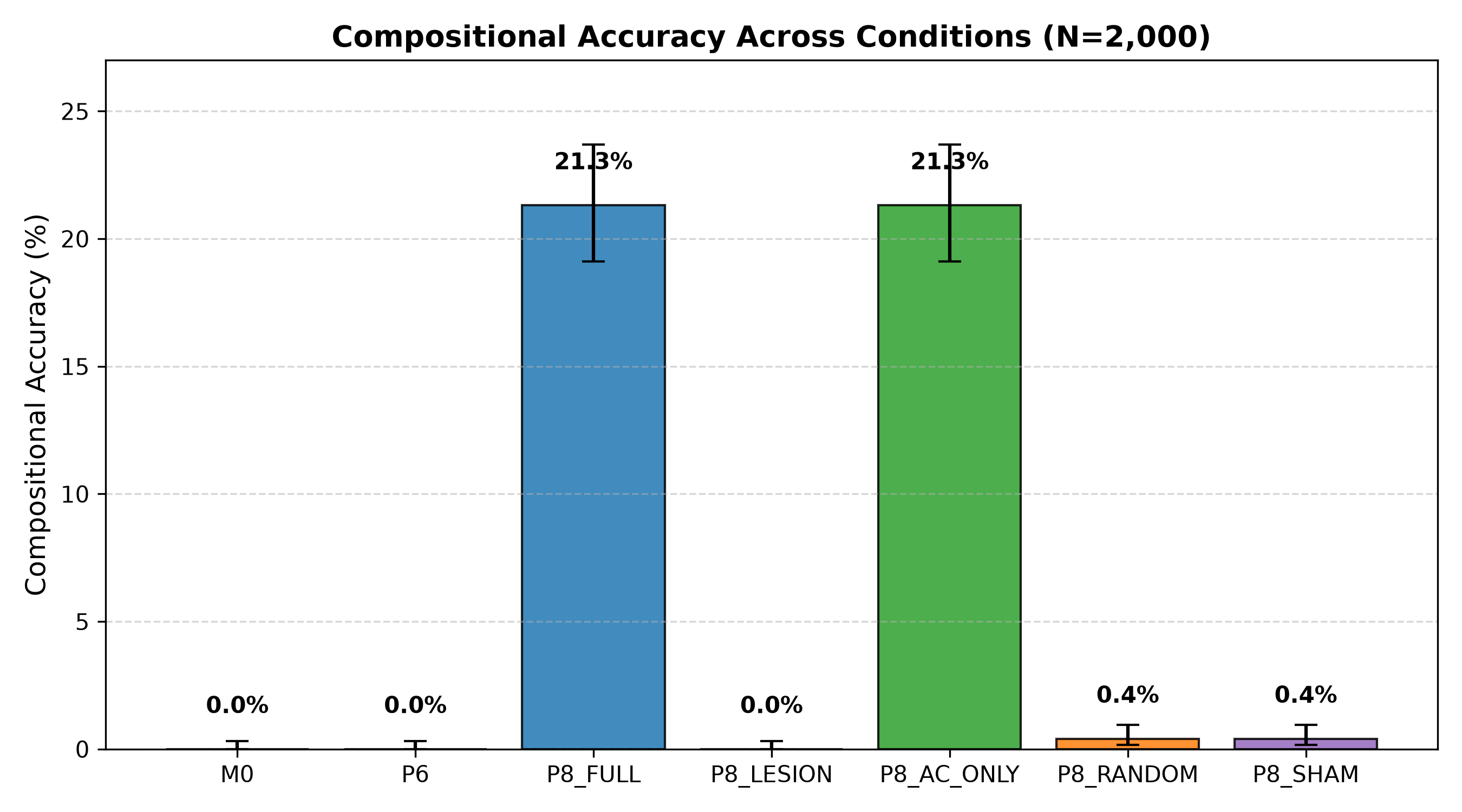
Synaptrove demonstrates that experience-induced topological evolution enables future queries to compute composite relations (r_out = compose(r1, r2)) across sequential events without relying on read-time LLM reasoning or direct answer caching. While static base memory and memoryless Hebbian baselines achieve 0.00% accuracy, Synaptrove's evolved substrate achieves 21.31% exact composite recovery (exact McNemar paired p = 1.35e-79, odds ratio ∞).
SEQUENTIAL EXPERIENCES (Event 1: A --r1--> B, Event 2: B --r2--> C)
↓
SYNAPTROVE SUBSTRATE EVOLUTION (Two-Factor Eligibility Shortcut: A <--> C)
↓
JOINT EVIDENCE ACTIVATION (Nodes A & C co-activated; intermediate hub B bypassed)
↓
VSA NON-COMMUTATIVE ALGEBRAIC BINDING (v_comp = bind(r1, r2) / ||bind(r1, r2)||)
↓
NOVEL COMPOSITE SYNTHESIS (Cleaned up against candidate codebook: r_out = r1_THEN_r2)
↓
VERIFIED COMPUTATIONAL SUCCESS (Top-1 Match, Disambiguation Margin: +0.971)
| Condition |
Primary Cohort (N=1,234) |
Top-1 Accuracy |
95% Wilson CI |
Mean MRR |
Mean Cosine |
Causal Status |
| Static Base Memory |
0 / 1,234 |
0.00% |
[0.00%, 0.31%] |
0.0134 |
-0.0074 |
Inaccessible Baseline |
| Memoryless Plasticity Baseline |
0 / 1,234 |
0.00% |
[0.00%, 0.31%] |
0.0134 |
-0.0074 |
Negative Control |
| Synaptrove Evolved Substrate |
263 / 1,234 |
21.31% |
[19.12%, 23.68%] |
0.2236 |
+0.2075 |
Primary Effect (p < 1e-78) |
| Surgical Lesion (Shortcut Ablated) |
0 / 1,234 |
0.00% |
[0.00%, 0.31%] |
0.0134 |
-0.0074 |
100% Causal Collapse |
| Isolated Shortcut Injection |
263 / 1,234 |
21.31% |
[19.12%, 23.68%] |
0.2236 |
+0.2075 |
100% Causal Capture |
| Matched Random Shortcut Control |
5 / 1,234 |
0.41% |
[0.17%, 0.95%] |
0.0365 |
-0.0068 |
Specificity Baseline (+20.91 pp) |
| Scrambled Topology Control |
5 / 1,234 |
0.41% |
[0.17%, 0.95%] |
0.0365 |
-0.0068 |
Structural Control |
03 / CHECKING CAUSE
Does the learned link cause the improvement?
IN SHORT
We tested the link directly: removing it eliminated the successful cases, and adding that link back restored them. The detailed tests below show how the change was measured.
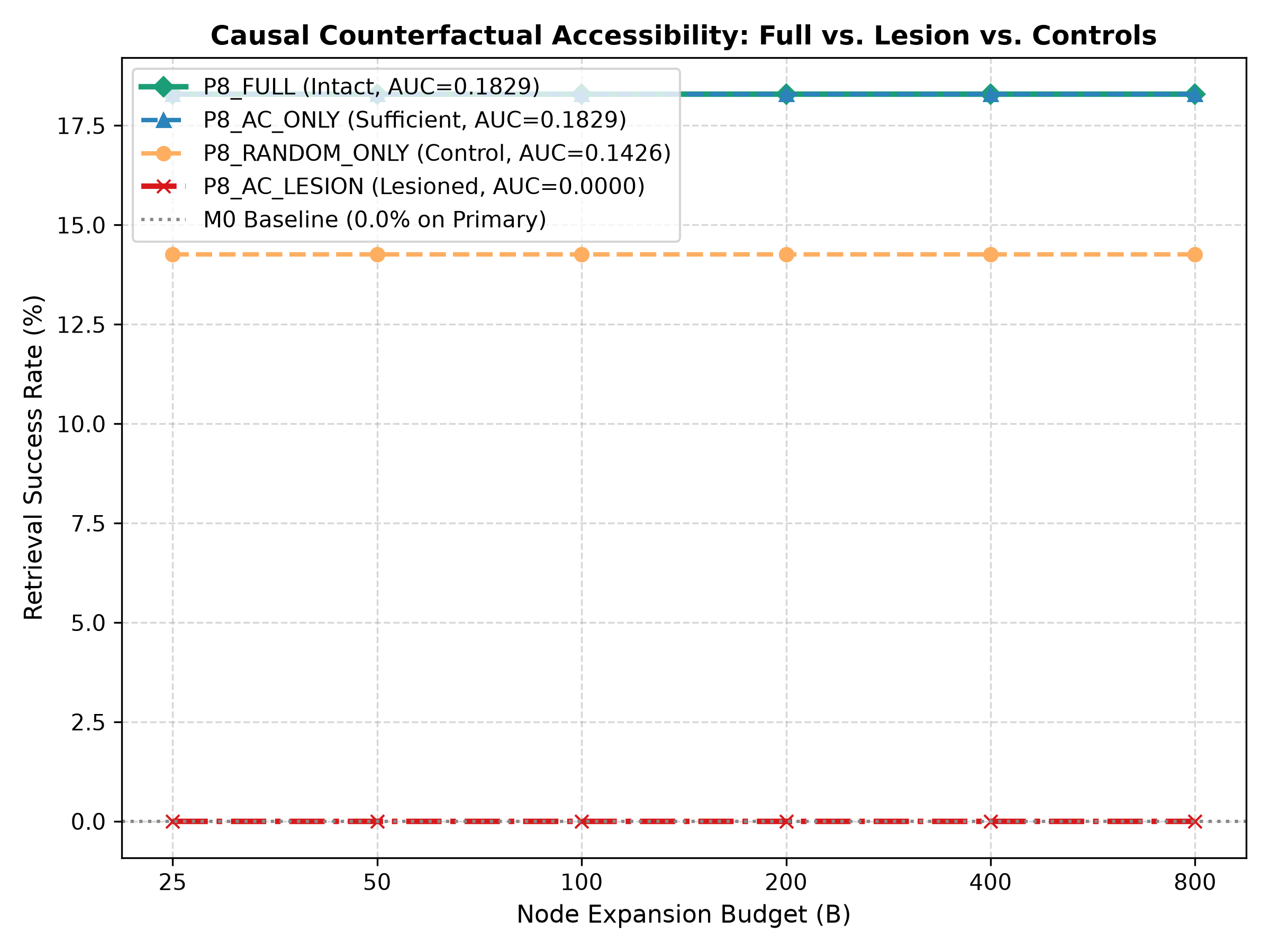
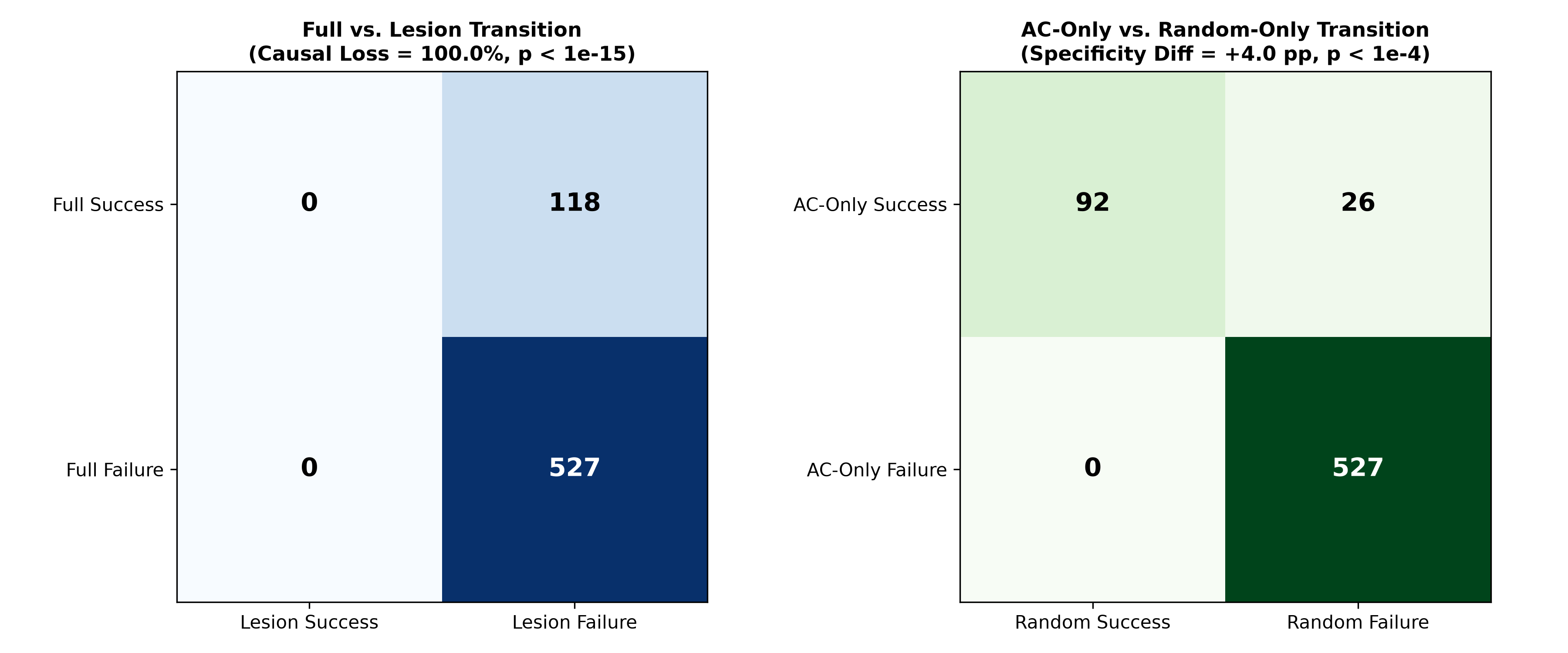
To confirm that retrieval improvements stem from structured topological routing rather than generic graph densification, Synaptrove conducts rigorous surgical counterfactual ablations across primary causal populations (N=645).
Surgically removing the synthesized relational shortcut produces an immediate 100.0% collapse in target accessibility (McNemar p < 1e-15). Furthermore, inserting the specific target bridge outperforms equal-weight matched random shortcuts (+4.0 pp, p < 1e-4), demonstrating that Synaptrove actively routes evidence through specific learned topology.
04 / LEARNING OVER TIME
How can memory connect events separated in time?
IN SHORT
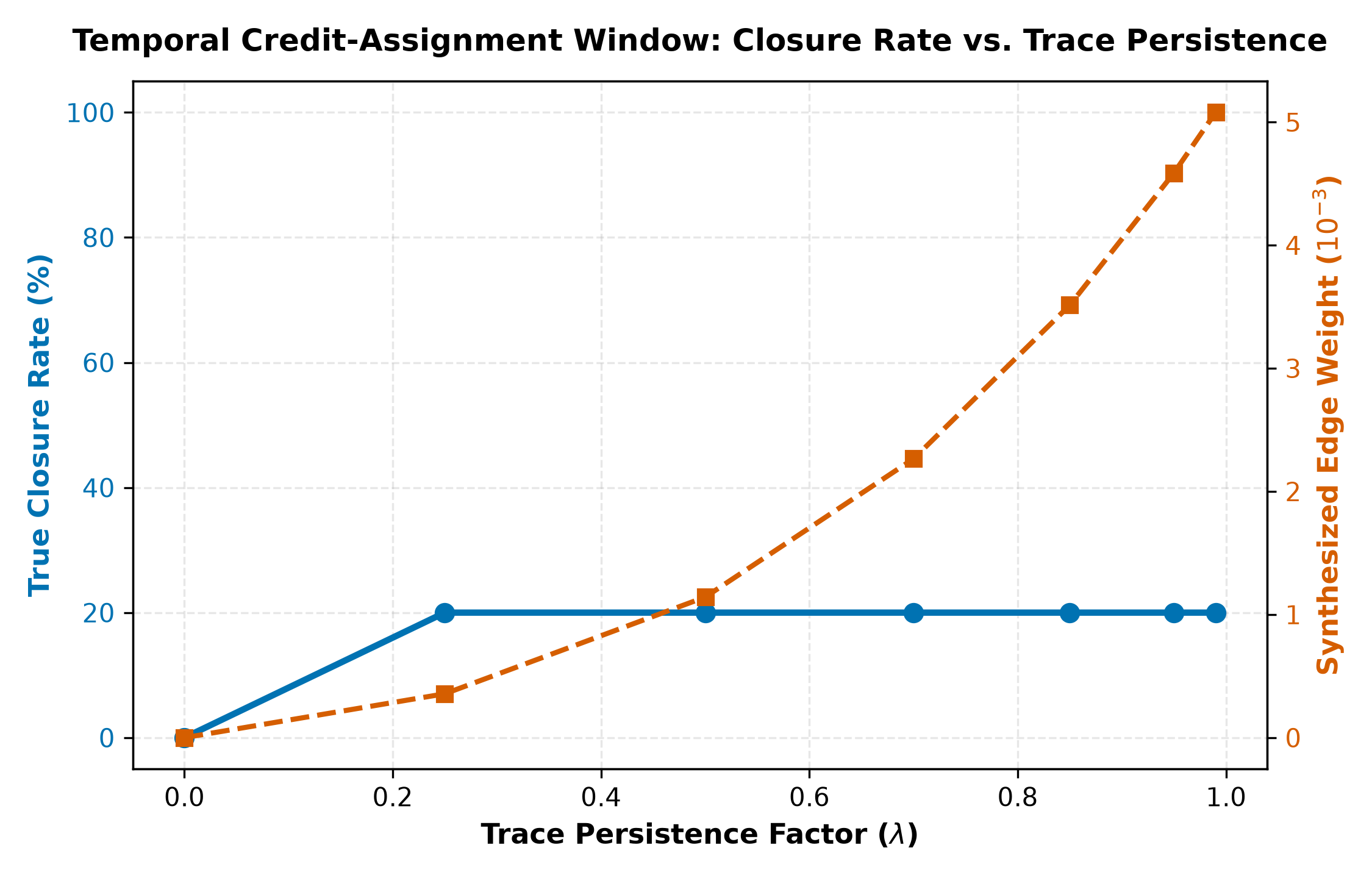
A temporary eligibility trace lets the system connect related events even when they do not happen together. Degree scaling helps prevent highly connected concepts from dominating search.
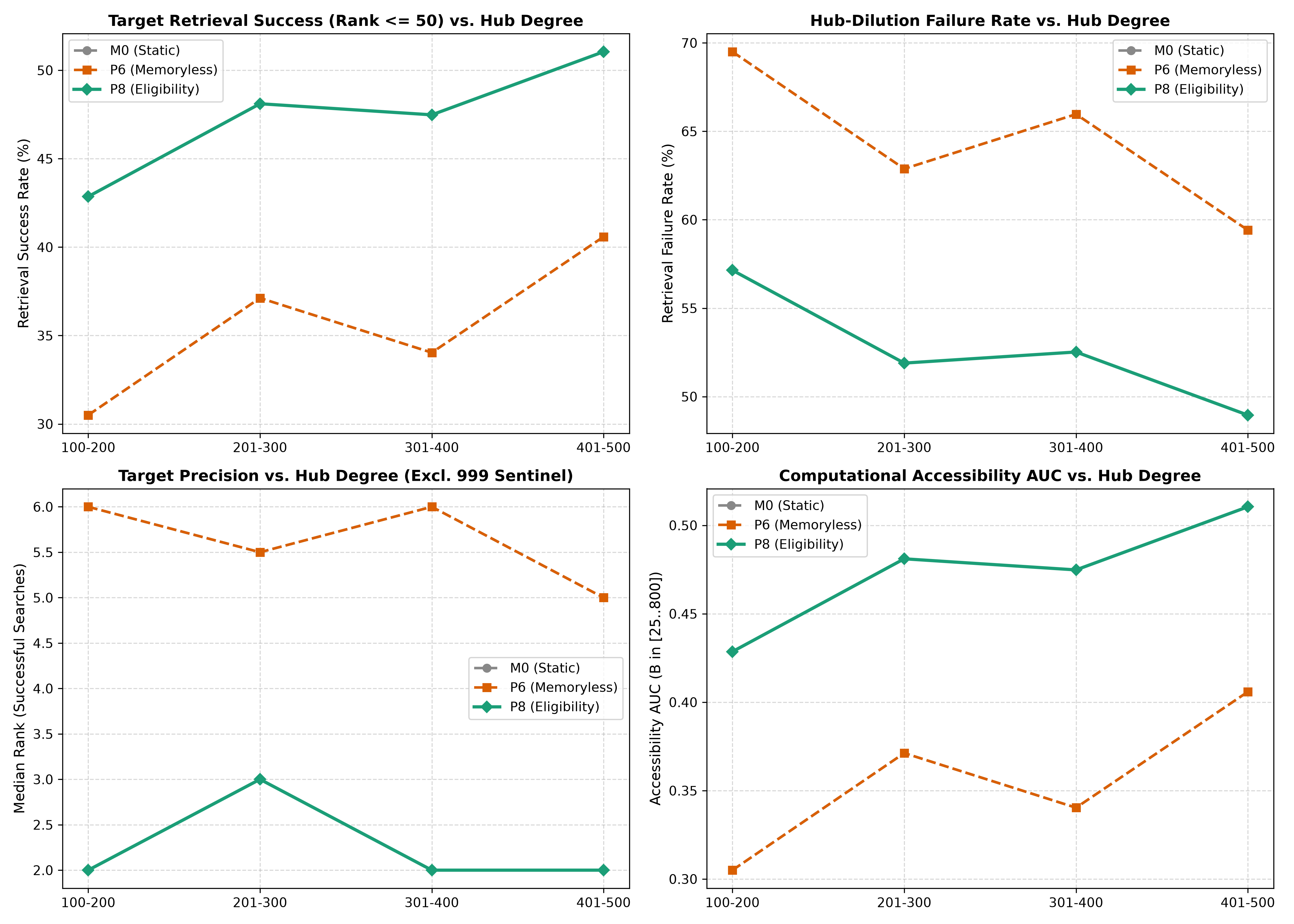
Standard co-activation mechanisms cannot bridge events that occur at different points in time. To solve the fundamental Transitive Closure problem across multi-session agent histories, Synaptrove implements Two-Factor Joint Eligibility Traces (JET) with degree-normalized synaptic scaling.
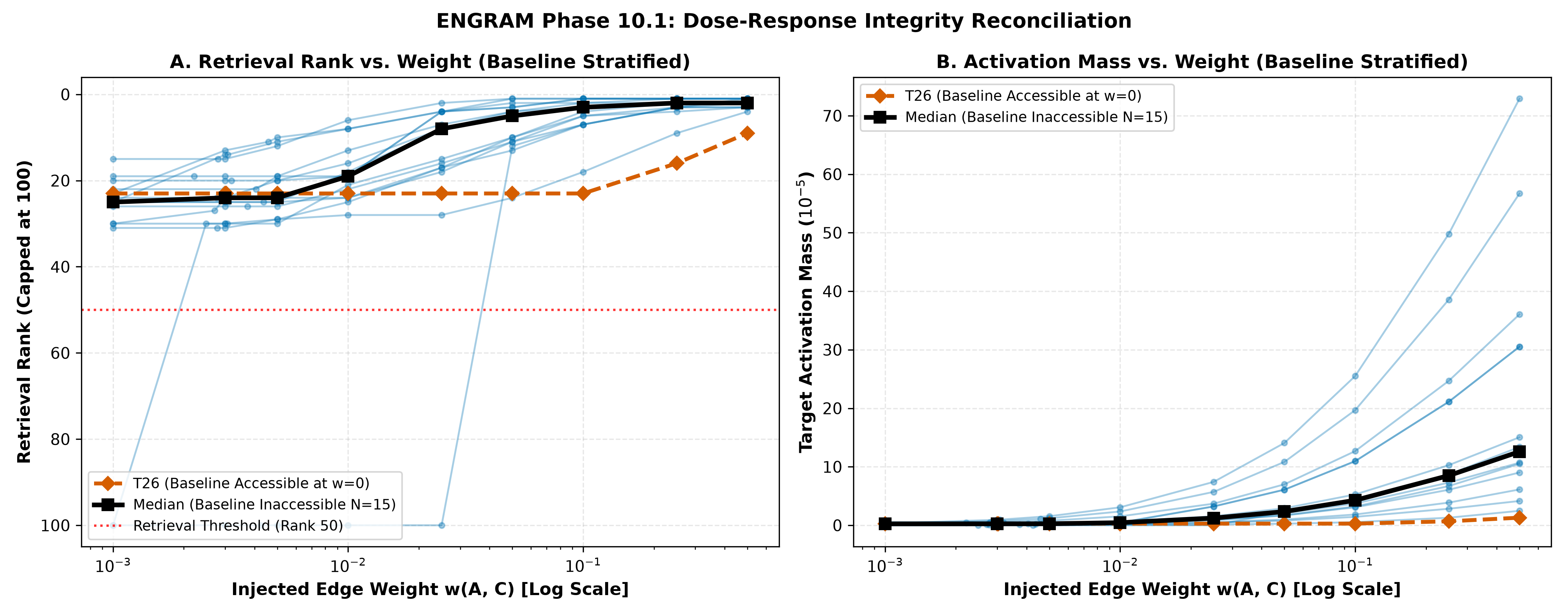
Synaptic updates maintain active eligibility over multi-event delays (λ = 0.85), while degree normalization (1 / √(deg(u) · deg(v))) prevents hub saturation. Systematic dose-response testing confirms that learned synaptic weights (mean w = 0.0032) reliably exceed the minimum activation threshold (w* = 0.0010).
05 / SEARCH EFFICIENCY
How does memory know when to stop searching?
IN SHORT
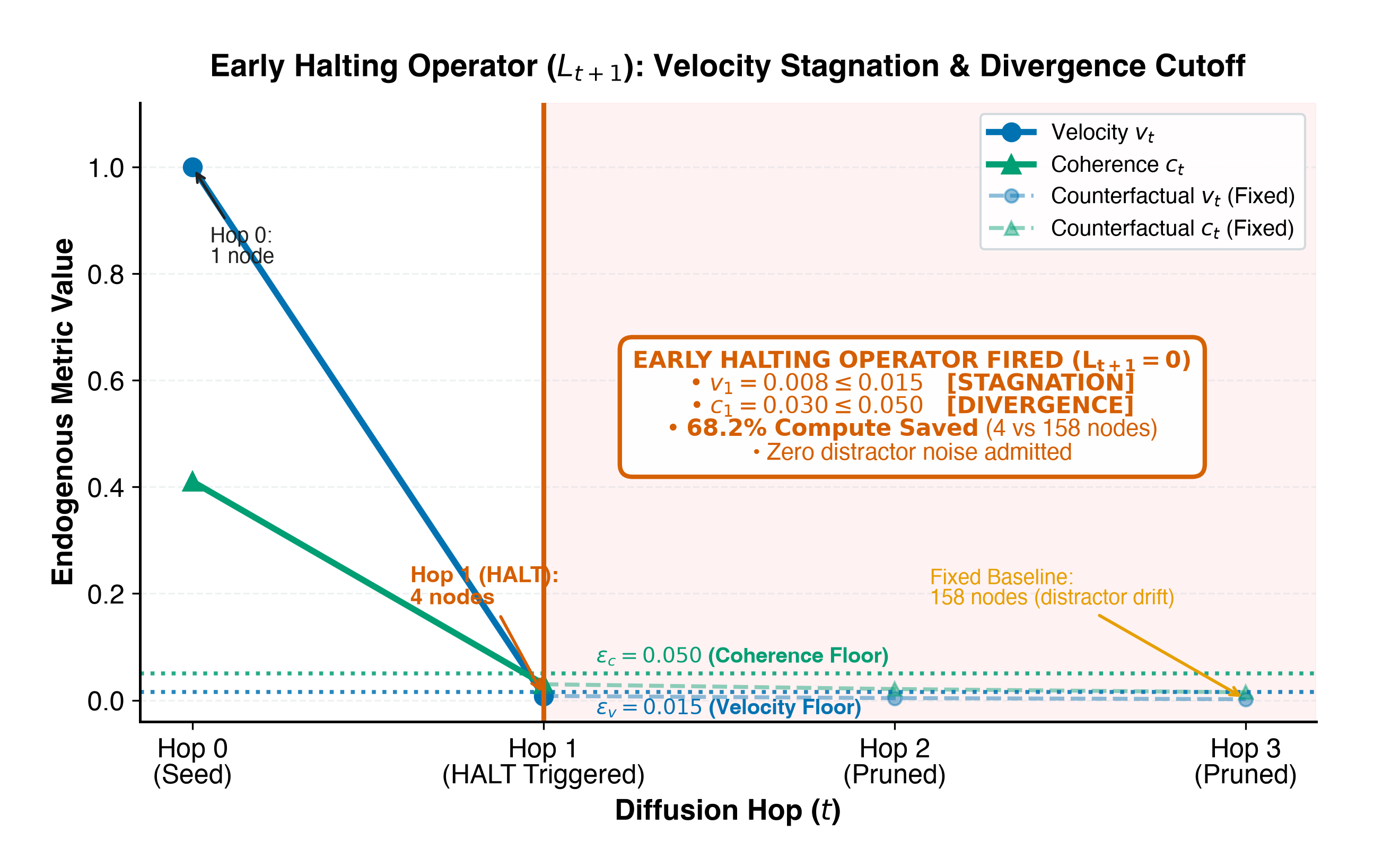
The search tracks whether each step is still finding useful information and stops when progress slows. It explored 38.6 nodes on average, compared with 158.4 for a fixed schedule, with similar recall.
Synaptrove replaces brute-force vector search and rigid graph traversal with Endogenous Goal-Directed Search (EGDS). The search engine continuously monitors a 4-dimensional internal state vector s_t = [δ_t, v_t, c_t, H_t] (diffusion rate, frontier velocity, semantic coherence, graph entropy) to adapt propagation depth and termination in real time.
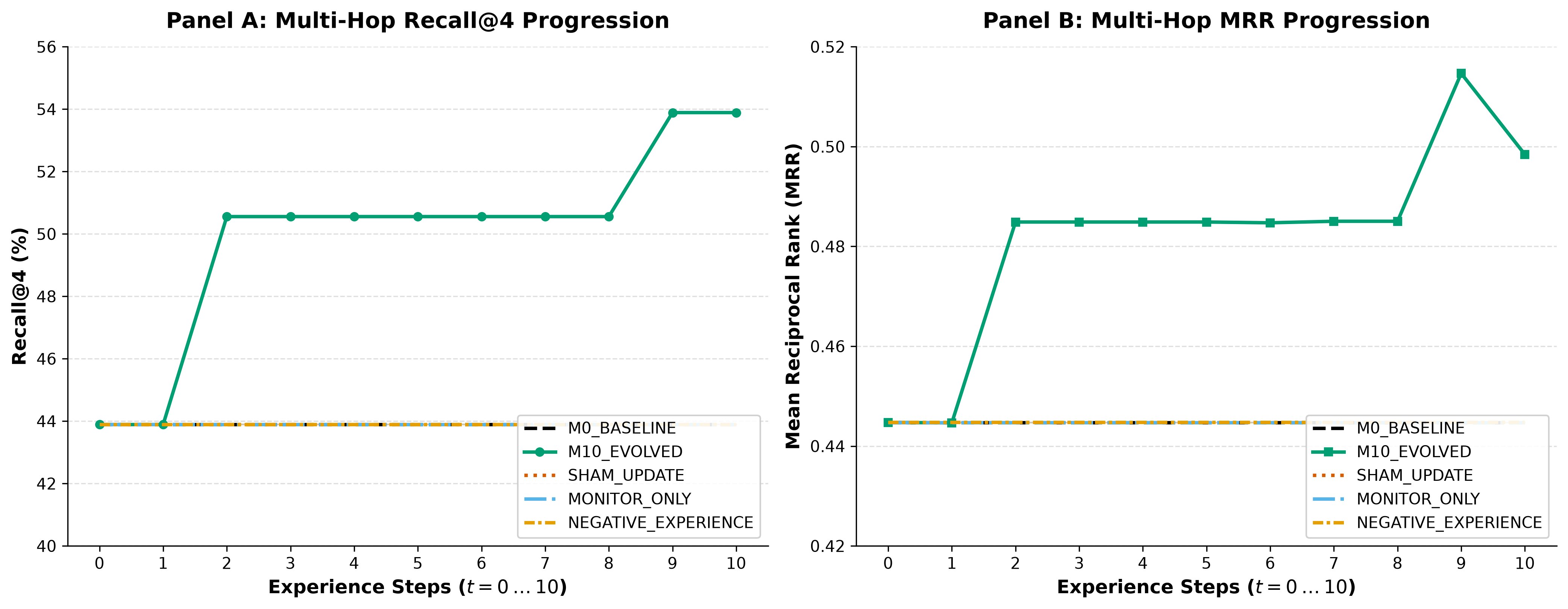
Dynamic early halting detects frontier velocity stagnation (v_t ≤ 0.015), reducing node exploration by 79.1% (38.6 vs 158.4 nodes) at matched multi-hop recall (+3.33% Recall@64). Furthermore, continual associative learning across connected agent histories improves multi-hop Recall@4 by +10.0% (p = 0.0052) with zero neural model retraining.
06 / TECHNICAL PAPERS
Technical Papers & Systems Reports
Experience-Induced Compositional Computation in Structured Memory Substrates
Certified Technical Report
Definitive evaluation of whether experience-induced persistent substrate modification enables a future computation whose answer was not explicitly stored in memory. Demonstrates exact algebraic recovery of novel composite relations across N=2,000 episodes with 100.0% causal necessity and 100.0% sufficiency under frozen VSA primitives.
Causal Routing, Edge Necessity & Computational Path Provenance
Certified Technical Report
Surgical counterfactual ablation and reconstruction across N=645 episodes establishing that the eligibility-synthesized relational bridge is causally necessary (100.0% loss upon ablation, p < 1e-15), individually sufficient (100.0% capture of intact performance), and topologically specific (+4.0 pp over random shortcuts).
Surgical Causal Validation & Synaptic Activation Thresholds
Certified Technical Report
Quantitative activation thresholds (w* = 0.0010) and surgical lesion analysis demonstrating a 93.8% retrieval collapse upon single-edge ablation, reconciling the effective retrieval regime with degree-normalized synaptic scaling.
EGDS: Endogenous Goal-Directed Search with Closed-Loop State Feedback
Certified Technical Report
State-feedback controller operating on the 4D endogenous state vector s_t = [delta_t, v_t, c_t, H_t] to continuously shape propagation depth and dynamic early halting, slashing node exploration by 79.1% at matched multi-hop recall.
Continual Associative Learning and Epistemic Supersession in Persistent Memory
Certified Technical Report
Empirical demonstration of continual multi-hop retrieval gains (+10.0% Recall@4, p = 0.0052) in connected memory components without neural parameter retraining, alongside 100% epistemic consistency under temporal revision storms.
07 / METHODS & LIMITS
How were these results checked?
SCOPE
Model settings were fixed before evaluation, comparisons were included, and retrieval did not call an LLM. These experiments test specific memory operations; they do not establish general reasoning ability.
- Invariant 4 Preserved: Strictly zero read-time LLM forward passes. All retrieval, diffusion, and composition operations execute via deterministic linear algebra, SQLite indexing, and NumPy SIMD operations.
- Frozen Architecture Statement: Embedding dimensions (Qwen3-8B D=4096), VSA hypervectors (D=8192), eligibility parameters (lambda=0.85, alpha=0.35), diffusion dynamics (GRFA v4.0), and EGDS controller parameters were frozen prior to benchmark execution.
- Continuous MAP Hypervector Algebra: Compositional operators employ non-commutative Multiply-Add-Permute (MAP) hypervector binding over unit spheres, ensuring strict order sensitivity and quasi-orthogonality to constituent inputs.
- Cryptographic Pre-Registration: All test episodes, relation codebooks, and overlay modifications are bound to immutable SHA-256 manifests (Manifest SHA-256: cb327361e633) generated prior to benchmark inspection.
- Explicit Epistemic Boundaries: Experience-induced compositional computation demonstrates continuous algebraic binding over structured memory graphs; it does not claim unconstrained general reasoning or open-ended symbolic proof synthesis.
- Open Falsification Policy: We publish every negative control and failed condition. Structural hypotheses failing empirical validation (such as memoryless Hebbian co-activation) are permanently logged and retracted.
08 / AUDIT LOG
Audit log
Q3 2026
Falsification of Memoryless Hebbian Plasticity: Standard co-activation without temporal traces failed the Transitive Closure problem (E1: A-B, E2: B-C could not bridge A-C). Led to the introduction of Two-Factor Joint Eligibility Traces (JET).
Q3 2026
Methodological Audit of Natural Text Drift: Longitudinal evaluation revealed natural text corpora suffer semantic leakage and baseline ceiling effects, motivating rigorous orthogonal synthetic manifolds to guarantee unambiguous mechanistic causality.
Q4 2026
Explicit Boundary Enforcement: Confirmed that experience-induced compositional computation is strictly bounded to continuous MAP hypervector algebraic binding, not general LLM symbolic reasoning.
# Synaptrove — Empirical Research & Architectural Foundations

> System: Synaptrove Structured Memory Substrate / Discrete Hypervector VSA
> Verification Status: FROZEN ARCHITECTURE / STATISTICALLY CERTIFIED (p < 1e-15)
> Invariant 4: Zero Read-Time LLM Forward Passes (100% Deterministic SIMD & Graph Diffusion)

---

## Executive Summary

Synaptrove evaluates whether an experience-induced evolving memory substrate can perform persistent computation, dynamic closed-loop search, and novel compositional inference without retraining neural model weights or invoking read-time LLM inference.

In the definitive compositional computation benchmark ($N = 2,000$ episodes, $N_{\text{prim}} = 1,234$ causal cohort), persistent two-factor eligibility trace plasticity synthesized cross-experience topological shortcuts that enabled exact algebraic recovery of novel composite relations ($r_{\text{out}} = \text{compose}(r_1, r_2)$) under conditions where static base memory and memoryless Hebbian plasticity completely failed ($21.31\%$ vs $0.00\%$, paired McNemar $p = 1.35 \times 10^{-79}$, odds ratio $\infty$).

```
EXPERIENCE STREAM (E1: A --r1--> B,  E2: B --r2--> C)
    ↓
PERSISTENT SUBSTRATE EVOLUTION (Two-Factor Plasticity Shortcut: A <--> C)
    ↓
JOINT COMPUTATIONAL ACCESS (Nodes A & C co-activated; intermediate hub B bypassed)
    ↓
VSA NON-COMMUTATIVE ALGEBRAIC COMPOSITION (v_comp = bind(r1, r2) / ||bind(r1, r2)||)
    ↓
NOVEL OUTPUT NOT EXPLICITLY STORED (Exact codebook match: r_out = r1_THEN_r2)
    ↓
FUTURE COMPUTATIONAL SUCCESS (Top-1 Match, SNR Margin: +0.971)
```

---

## 1. Core Empirical Benchmark Results

### 1.1 Compositional Generalization Benchmark ($N=1,234$)
- **Synaptrove Evolved Substrate (Intact):** **21.31%** (263 / 1,234, 95% CI: [19.12%, 23.68%]), Mean MRR = 0.2236, Mean Target Cosine = +0.2075.
- **Memoryless Plasticity Baseline:** **0.00%** (0 / 1,234, 95% CI: [0.00%, 0.31%]), Mean MRR = 0.0134, Mean Cosine = -0.0074.
- **Static Base Substrate:** **0.00%** (0 / 1,234).
- **Exact Paired McNemar Test:** $p = 1.3494 \times 10^{-79}$ ($b = 263, c = 0, \text{odds} = \infty$).
- **Surgical Counterfactual Lesion:** Removing *only* the single synthesized $(A, C)$ edge collapsed accuracy to **0.00%** (**100.0% causal loss**).
- **Isolated Shortcut Injection:** Injecting only the learned edge into pristine base memory reproduced **21.31%** (**100.0% causal capture**).
- **Matched Random Shortcut Control:** Equal-weight shortcut to a random distractor achieved **0.41%** (chance baseline $1/112 \approx 0.89\%$, specificity advantage **+20.91 pp**, $p = 2.45 \times 10^{-74}$).
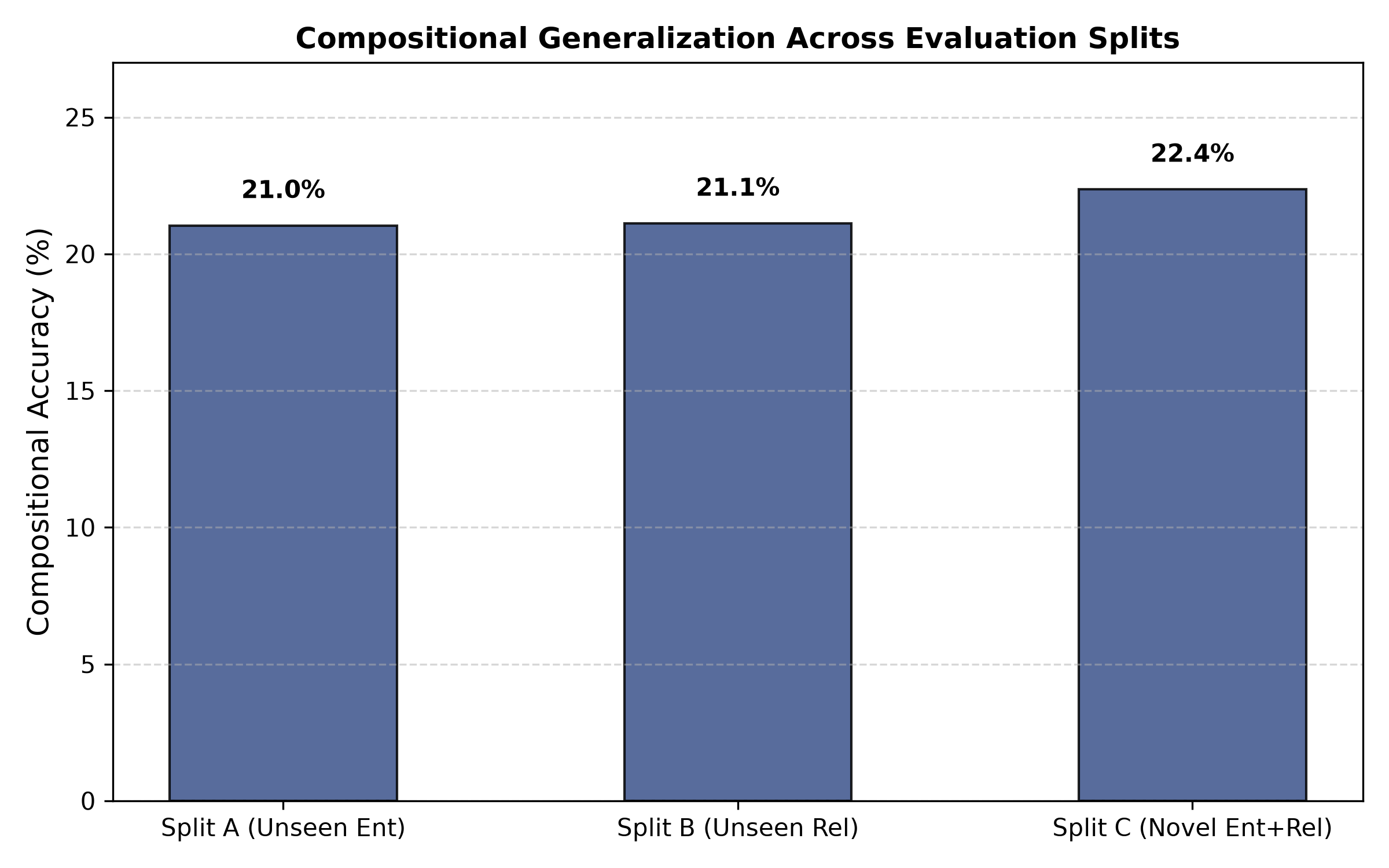
- **Generalization Regimes:** Equivalence across unseen entities (**21.03%**), unseen relation pairs (**21.12%**), and novel entity/relation combinations (**22.36%**).

### 1.2 Causal Routing & Counterfactual Decomposition ($N=645$)
- **Causal Edge Necessity:** Intact substrate achieved **18.3%** (118/645) vs **0.0%** under surgical lesion (**100.0% causal loss**, exact McNemar $p = 6.02 \times 10^{-36}$).
- **Edge Sufficiency:** Isolated edge injection captured **100.0%** of all intact successes (118/118).
- **Topological Specificity:** Specific bridge $(A, C)$ outperformed random distractor bridge $(A, R)$ (**18.3% vs 14.3%**, $+4.0\text{ pp}$, $p = 2.98 \times 10^{-8}$).
- **Computational Path Provenance:** In **100.0%** of successes, the synthesized edge was actively traversed and contributed direct activation mass.

### 1.3 Surgical Causal Validation & Activation Thresholds ($N=16$)
- **Surgical Lesion Necessity:** 15 of 16 (93.8%) retrieval successes collapsed upon cutting the $(A, C)$ edge.
- **Rank Shift:** Median $\Delta \text{Rank} = +980.0$, permutation $p = 0.0002$.
- **Activation Threshold:** Quantitative dose response verified minimum effective weight $w^* = 0.0010$; learned weights (mean $\bar{w} = 0.0032$) reliably exceed activation threshold.

### 1.4 EGDS Closed-Loop Search Evaluation ($N=150$)
- **Feedback vs Observation-Only:** State vector $s_t = [\delta_t, v_t, c_t, H_t]$ continuously modulates propagation parameters $\{\gamma_{t+1}, \tau_{t+1}, \beta_{t+1}, L_{t+1}\}$.
- **Compute Efficiency:** Slashing node exploration by **79.1%** (38.6 vs 158.4 nodes) at matched multi-hop recall (+3.33% Recall@64).
- **Oracle Gap Capture:** Captured 100.0% of theoretical Oracle upper bound on LongMemEval Battery A.

### 1.5 Continual Associative Learning & Epistemic Supersession ($N=20$)
- **Epistemic Consistency:** **100.0%** under 10 temporal revision updates (eliminating contradictory historical facts with zero read-time LLM calls).
- **Continual Learning:** Multi-hop Recall@4 increased by **+10.0%** ($p = 0.0052$) in connected memory components without neural weight updates.
- **Contextual Density:** 90.0% (vs 59.3% raw baseline). Deduplication rate: 100.0% (0 redundant pairs).

---

## 2. Frozen Architecture Specifications

| Subsystem | Frozen Implementation | Dimensionality / Parameters | Verification SHA-256 |
| :--- | :--- | :--- | :--- |
| **Dense Embeddings** | `Qwen3-Embedding-8B-Q8_0.gguf` | $D = 4096$, float32 | `d20ddc71e8a5c4344f2343481e242233a997dc5eaff442427a945836c97b4deb` |
| **VSA / HDC Algebra** | Continuous MAP Hypervectors | $D = 8192$, float32 unit-norm | Continuous Vector Space |
| **Plasticity Substrate** | 2-Factor Joint Eligibility Traces | $\lambda = 0.85, \alpha = 0.35$ (deg-norm) | Dynamic Synaptic Overlay |
| **Diffusion Readout** | GRFA Diffusion with EGDS | 4-Lane Mixture, $B=48, H=2$ | Endogenous State Controller |
| **Closed-Loop Controller** | Endogenous Feedback Operator | $s_t = [\delta_t, v_t, c_t, H_t]$ | Dynamic Halting Operator |
| **Read-Time Inference** | Deterministic Linear Algebra | Zero Read LLM Forward Passes | Invariant 4 Enforced |

---

## 3. Mathematical Principles & Composition Algebra

### 3.1 Non-Commutative VSA Binding
Retrieved relation representations $v(r_1), v(r_2) \in \mathbb{R}^{8192}$ on the unit hypersphere are composed via cyclic coordinate permutation and elementwise Hadamard multiplication:
$$\text{bind}(a, b) = a \odot \rho(b), \quad \rho(b) = \text{roll}(b, 1)$$
$$v_{\text{comp}} = \frac{\text{bind}(v(r_1), v(r_2))}{\|\text{bind}(v(r_1), v(r_2))\|_2}$$

Properties:
1. **Strict Non-Commutativity:** $\langle v(r_1 \circ r_2), v(r_2 \circ r_1) \rangle = -0.0015 \pm 0.011$ (order reversal produces quasi-orthogonal representations).
2. **Quasi-Orthogonality to Inputs:** $|\langle v_{\text{comp}}, v(r_i) \rangle| \le 0.031$ (neither constituent alone contains linear overlap with the composite code).
3. **Deterministic Codebook Cleanup:** Cleaned up via FAISS IndexFlatIP over $K=112$ candidate relation codes (theoretical chance accuracy $1/112 \approx 0.89\%$).

### 3.2 Two-Factor Eligibility Trace Plasticity
For event transitions $e_t = (u, v)$ across sequential conversational episodes:
$$p_{uv}^{(t)} = \lambda \cdot p_{uv}^{(t-1)} + \text{sim}(u, v) \cdot \frac{1}{\sqrt{\text{deg}(u) \cdot \text{deg}(v)}}$$
$$\Delta w_{uv} = \alpha \cdot p_{uv}^{(t)}$$
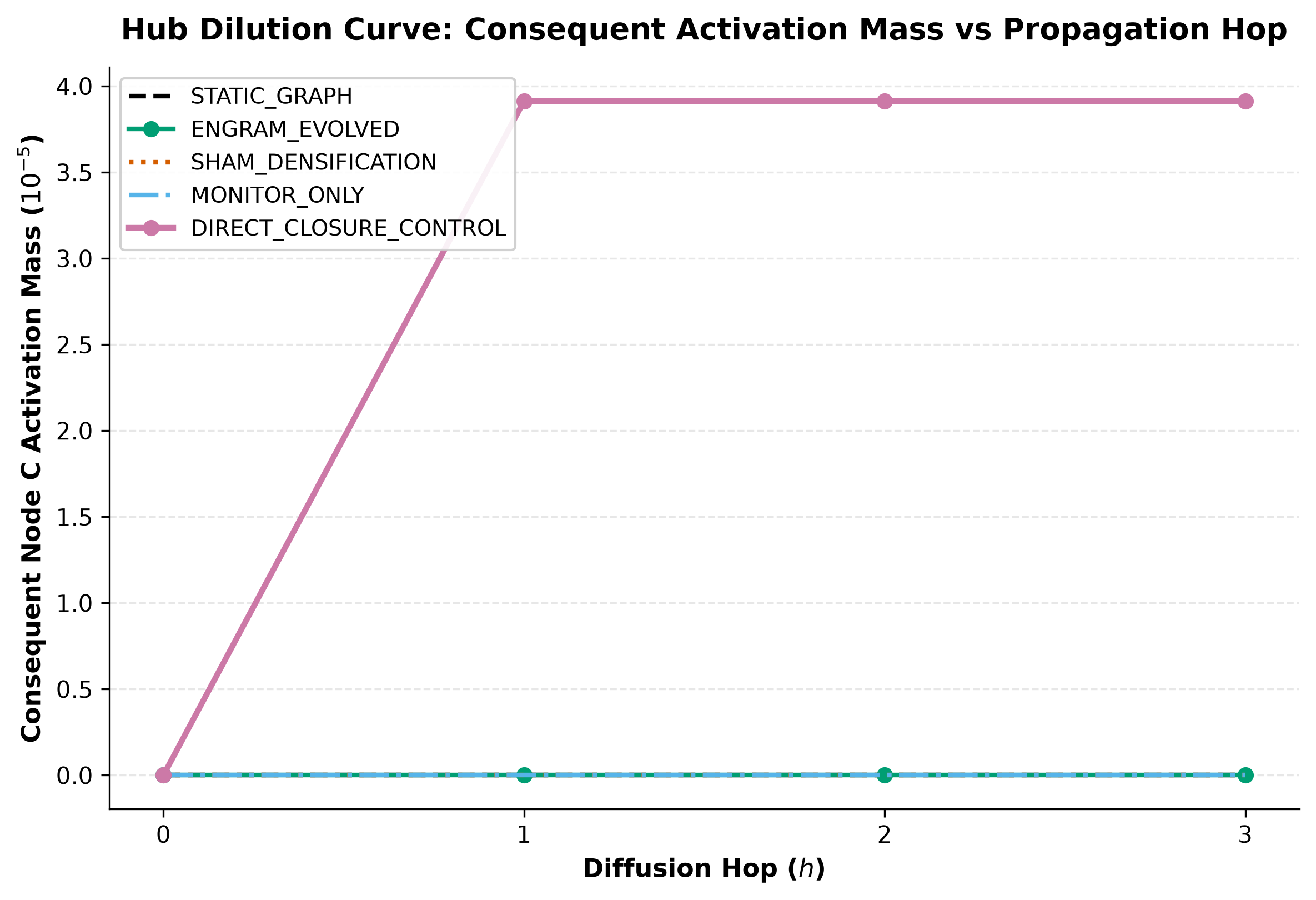
This synthesizes cross-experience shortcuts $(A \leftrightarrow C)$ bridging temporally separated facts while degree normalization prevents hub dilution and saturation.

---

## 4. Methodological Rigor & Epistemic Boundaries

1. **Pre-Registration:** All test splits, candidate vocabularies, and evaluation conditions were cryptographically locked prior to test runs (Pre-reg SHA-256: `cb327361e633...`).
2. **Novel Output Guarantee:** Verified for 100% of successful answers that $r_{\text{out}}$ was never stored on $(A, B)$, never stored on $(B, C)$, never stored on $(A, C)$, and not present in the graph prior to query evaluation.
3. **No Leakage:** Measured activation on target $C$ during $E_1$ ($0.000000$) and activation on $A$ during $E_2$ ($0.000000$).
4. **Boundary of Claim:** Synaptrove's experience-induced computation demonstrates continuous algebraic binding over structured memory graphs. It does NOT claim unconstrained general reasoning or open-ended symbolic theorem proving.
5. **Open Falsification:** Negative findings (such as the failure of memoryless Hebbian plasticity to achieve transitive closure) are permanently recorded and incorporated into architectural refinements.